LieppOS research wiki
Open research and engineering documentation for the Ulefone Armor 29 Pro Thermal (GQ5012BF1).
The site is generated with mdBook and hosted using GitHub Pages. The authoritative research and source documents live in LieppOS/LieppOS-ulefone-gq5012bf1-research.
Where to begin
- Understanding evidence explains the difference between discovery, configuration, build validation and device runtime validation.
- Research archive appears in the navigation after importing the public research repository.
- LieppOS GitHub organization contains associated projects and source code.
Documentation is exploratory and may include hypotheses, unsuccessful experiments, and device-specific findings. Always check the original document and its validation status before using technical procedures, particularly ones involving bootloaders and partitions.
Understanding evidence
Every claim on this site carries an evidence label. The labels are not interchangeable success states: a compile result, a descriptor check, a source comparison and a hardware observation are different kinds of knowledge, and they are never promoted into one another.
The labels
| Label | Meaning | What it does not prove |
|---|---|---|
| VERIFIED ON DEVICE | Observed on the physical GQ5012BF1, almost always on stock firmware. | That the same behaviour occurs under a LieppOS-built kernel. |
| VERIFIED OFFLINE | Established from authenticated images or captures, or from a reproducible local build and verification run. | Hardware behaviour, bootloader acceptance, or that Android starts. |
| SOURCE-LEVEL VERIFIED | Established by reading source, a device tree, a configuration symbol or a manifest. | That the code ever executes, or that the value is right for this board. |
| STRONG INFERENCE | Several independent observations converge, but no direct measurement exists. | Fact. A strong inference can still be wrong. |
| EXPERIMENTAL | Exercised outside any supported configuration and kept as forensic evidence. | Support, roadmap status, or fitness for use. |
| MANUFACTURER CLAIM | Stated by Ulefone or MediaTek product or marketing material. | Electrical or software reality. |
| UNKNOWN | Not established. Recorded explicitly so that the gap stays visible. | — |
| PLANNED | Intended work that does not exist yet. | Availability. A planned repository is not a published one. |
Where a page cites an earlier convention, SOURCE-LEVEL is shorthand for SOURCE-LEVEL VERIFIED, and “manufacturer marketing name” is shorthand for MANUFACTURER CLAIM. Neither shorthand weakens the rule that the claim has only the strength its label describes.
Three rules that are easy to break
- A successful kernel compilation is not proof that a driver works on the phone. Building shows that source and configuration agree; it says nothing about a probe, a clock, a regulator or a panel.
- A successful AVB verification with a development key is not proof of bootloader acceptance. Descriptor integrity and lock-state enforcement are separate mechanisms. See AVB and trust.
- A successful module dependency closure is not proof that Android boots. Link closure, first-stage placement and runtime behaviour are three different checks. See DLKM partitions.
What a runtime claim needs
A valid build result needs a committed source graph, declared non-Git inputs, an effective configuration, compiler identity, generated headers, strict modpost and a complete module manifest. A runtime claim additionally needs independently authorized observation on the hardware itself.
| Claim | Sufficient evidence |
|---|---|
| “It builds” | source lock + configuration + toolchain + strict modpost + module manifest |
| “It is ABI-closed” | Module.symvers, CRCs and a dependency graph per partition |
| “The descriptor is valid” | authenticated image + recomputed hashtree + root binding |
| “It boots” | hardware observation only |
| “The driver works” | hardware observation only |
Current standing
As of the C28 baseline documented here:
- Hardware validation of any custom image: 0. The LieppOS kernel has never been booted on this device.
- Strict stock-module certification: 440 / 458. Experimental: 6 / 458.
- The C28 boot package is
OFFLINE_PREFLIGHT_FAILEDand is not deployable.
Nothing on this site describes a flash-ready artifact. See Current status and Known limitations.
Where the raw evidence lives
The research repository holds raw captures, logs and per-campaign reports. This book is a curated explanation of that evidence, not a replacement for it. See Methodology and Evidence index.
Project overview
LieppOS is organised like a LineageOS device project: independent source repositories pinned by one manifest, one build-orchestration engine, and separate repositories for the Android device tree, recovery, research and these docs.
| Responsibility | Owner | Repository |
|---|---|---|
| Board kernel source (defconfig, platform + board DTS) | kernel maintainers | android_kernel_ulefone_gq5012bf1 (planned) |
| Vendor kernel modules (Mali, camera, imgsensor, connectivity, MET) | kernel maintainers | one repository each (planned) |
| FPSGO/C2PS performance source | performance maintainers | android_kernel_mediatek_performance (planned, private) |
| Build orchestration, ABI checks, receipts | build maintainers | android_build_lieppos (planned) |
| Android device configuration | device maintainers | android_device_ulefone_gq5012bf1 |
| Recovery | recovery maintainers | OrangeFox-Ulefone-GQ5012BF1 |
| Research and evidence | everyone | LieppOS-ulefone-gq5012bf1-research |
“Planned” repositories exist locally with their full Git history but have not been published; see Repositories.
Two independent workflows share the device:
- a GSI (LineageOS 23.2 / Android 16, TrebleDroid) on the stock kernel and vendor, and
- a full-device ROM (Android 15 / LineageOS 22.2-era device tree) that will eventually use the source-built LieppOS kernel.
They are never combined in one checkout. Start with Current status.
Current status
As of Campaign 28 (2026-10-26), research revision ae6dce06.
| Area | Status |
|---|---|
| Stock module certification (strict) | 440 / 458 |
| LieppOS experimental OK | 6 / 458 |
| Hardware validation of any custom image | 0 |
| Custom kernel | 6.1.115-mt6878-gq5012bf1-dev21+ builds from pinned source; not boot-validated |
| Kernel + FPSGO/C2PS | …-dev21-perf1+ builds, 744 modules, strict modpost; acceptance HOLD |
| C26/C27 boot package | raw-image package, PASS_OFFLINE_NON_DEPLOYABLE |
| C28 Slot-B readiness | OFFLINE_PREFLIGHT_FAILED — 4 blockers |
| GSI | LineageOS 23.2 / Android 16 on the stock kernel |
| Full-device ROM | Android 15 device tree with stock kernel, DTB and DTBO |
| Recovery | OrangeFox Build36 released; overlay model prepared |
C28 blockers
slot_b_userspace_capacity · slot_b_current_a17_content_incompatible · bootloader_boot_hash_vs_chain_unverified · source_divergent_modules_runtime.
Research line has not been merged
The research repository’s integration line is 23 commits ahead of master; C23–C29 and C32 live on integration/* branches. This book documents the C28 baseline (ae6dce06). C29 (011b9224) and C32 (cf36c62a) are Android 17 Slot-B forensics, both ANDROID17_OFFLINE_PREFLIGHT_FAILED; they are experimental, off-roadmap, and never booted. See Roadmap and Android 17 Slot-B.
Kernel build reproducibility
The build engine rebuilt dev21 from committed source and compared it with the independent C21 build:
- effective config,
vmlinux.symvers, mixed-tree export table,modules.builtin, kernel release: identical; Module.symvers(19,759 exports, every CRC): identical;- 732 of 740 same-named modules: identical code and data after removing debug info and build-id;
- the remaining 8 and the kernel image still differ. Full binary equivalence is not certified; see Building.
What “not boot-validated” means
The gates that cannot pass offline are listed in Boot chain and AVB and trust: first-stage modules.load placement, dtbo.img, the trusted board description, bootconfig, AVB/LK acceptance, module signing at runtime and hardware testing.
Nothing on this site describes a deployable image.
Roadmap
- Publish source (owner decision): kernel, vendor modules, build engine and manifest, after the license review (Provenance). The donor module-signing key in the kernel tree must be replaced first.
- Complete kernel history: fetch the Android Common Kernel ancestry of
6b18f0bso the published kernel is no longer shallow (no LieppOS commit changes). - First-stage boot contract: obtain an authorized vendor_boot ramdisk
modules.loadand bootconfig, then builddtbo.imgfrom the trusted overlay. - Trusted board description: display, touch, charger and thermal-camera wiring from authenticated evidence.
- Performance: runtime validation of the FPSGO/C2PS integration (lockdep, KCSAN, hardware), then promotion from HOLD.
- Recovery: switch OrangeFox to the overlay model in a new release.
- Full-device ROM with the source-built kernel (Android 15 first; Android 16 later — never both at once).
Not on the roadmap
Android 17 is not a LieppOS target. The Slot-B Android 17 work was bring-up forensics only; see Android 17 Slot-B experiment.
Open owner decisions
- Publication of the kernel and vendor module sources (license and signing-key review).
- Slot-B capacity: fitting the stock Android 15 userspace would require shrinking Slot-A logical partitions, which is prohibited without explicit owner approval.
- Production AVB signing policy.
Repositories
| Repository | Checkout path | Status |
|---|---|---|
android_manifest_lieppos | (manifest) | local, not published |
android_kernel_ulefone_gq5012bf1 | kernel/ulefone/gq5012bf1 | local, not published (private until the signing-key decision) |
android_kernel_arm_mali | vendor/mediatek/kernel_modules/mali | local, not published (license review) |
android_kernel_mediatek_mtkcam | vendor/mediatek/kernel_modules/mtkcam | local, not published |
android_kernel_mediatek_imgsensor | vendor/mediatek/kernel_modules/mtkcam/imgsensor/src-v4l2 | local, not published (nested, independent) |
android_kernel_mediatek_connectivity | vendor/mediatek/kernel_modules/connectivity | local, not published (license review) |
android_kernel_mediatek_met | vendor/mediatek/kernel_modules/met_drv_v3 | local, not published (provenance review) |
android_kernel_mediatek_performance | vendor/mediatek/kernel_modules/performance | local, private |
android_build_lieppos | tools/lieppos-build | local, not published |
android_device_ulefone_gq5012bf1 | device/ulefone/gq5012bf1 | public |
OrangeFox-Ulefone-GQ5012BF1 | recovery/ulefone/gq5012bf1 | public |
LieppOS-ulefone-gq5012bf1-research | — | public, canonical research |
android_vendor_lieppos | vendor/lieppos (GSI) | exists |
android_vendor_ulefone_gq5012bf1 | vendor/ulefone/gq5012bf1 | planned only (proprietary blobs) |
Every repository keeps its full development history. The kernel history starts at Android Common Kernel commit 6b18f0b574ab (earlier ancestry was never imported); see Provenance.
This website repository is separate from the research repository. Research is the source of truth; these pages are curated. See Evidence index.
Ulefone Armor 29 Pro Thermal
| Board | GQ5012BF1 |
| SoC | MediaTek MT6878T (kernel strings say mt6878) |
| Stock kernel | 6.1.115-android14-11-g945dff7bc1bf (GKI, android14-6.1) |
| Boot image | header v4, Image.lz4, A/B |
| Storage | UFS; the MediaTek host driver is a module (ufs-mediatek-mod) |
| Dynamic partitions | super, LP metadata 10.2, Virtual A/B |
| Special hardware | thermal camera (USB UVC module), secondary rear display, uSmart port |
| Verification baseline | Campaign 28, research revision ae6dce06 |
Pages
- Hardware — identified blocks with evidence labels
- Partition map —
super, A/B layout and Slot-B capacity - NFC — ST21NFC transport
- USB and uSmart — shared USB fabric and accessory port
- Known limitations — what is still unknown
- Development status — milestones and gates
Important
The LieppOS custom kernel has never been booted on this device. Hardware validation is 0. Everything in the hardware pages that is labelled VERIFIED was observed on stock firmware. A capability existing in stock does not prove it works under a LieppOS build.
Manufacturer marketing names (Dimensity 7400, Mali-G615 MC2, “uSmart 2.0”, “ThermoVue Pro”) are reported as marketing names, not as independently verified electrical facts.
Hardware
Every identified component on the board, and what it does.
| Status | Meaning |
|---|---|
| Verified | Observed on the device or established from authenticated images |
| Partly | The connection is proven, the behaviour is not |
| Claimed | Manufacturer specification only, not independently confirmed |
| Unknown | Not established |
Board wiring that has not been authenticated lives in the kernel’s provenance-pending device
tree, disabled by default (CONFIG_GQ5012BF1_PENDING_BOARD_DT=n).
No component here has been exercised under a LieppOS-built kernel. Hardware validation is 0.
Compute and memory
| Component | What it does | Status |
|---|---|---|
| MediaTek MT6878 (MT6878T) | Main SoC: arm64 CPU, Mali GPU, ISP, modem, and the SCP co-processor that runs the sensors | Verified |
| RAM | 16 GB LPDDR. Boot reports exactly 17179869184 bytes; LPDDR generation and part number are not identified | Verified (size) |
| RAM expansion | Up to 16 GB of storage-backed virtual RAM, sold as Dynamic RAM Expansion | Claimed |
| UFS storage | Flash holding every partition, driven by the ufs-mediatek-mod module | Verified |
| TrustKernel (tkcore) | Secure-world OS beside Android; handles fingerprint authentication and secure memory. Stock binaries, never redistributed | Verified |
| GenieZone | MediaTek protected execution environment for trusted workloads | Verified |
Display and touch
| Component | What it does | Status |
|---|---|---|
yft-lcm-vtdr6115-drv | Main LCD, 1080x2400, 60/90/120 Hz, density 480, on card0-DSI-1 | Verified |
| FocalTech FT3680 | Main touchscreen on SPI3, ten simultaneous points | Verified |
spi_tiny_lcd_co5300 | Rear 1.04 inch 340x340 AMOLED, over SPI0 via spi_tiny_co5300_lcd.ko | Verified |
Hynitron hyn_ts | Rear touch panel on I2C 0-0015, single tracking point | Verified |
The rear screen is not a second Android display. It is a vendor misc device
(/sys/class/misc/tiny_lcd_miscdev) that the YftMiniScreen app draws watch faces and
notifications onto. Android’s compositor never sees it.
Cameras
| ID | Sensor | Facing | Role | Flash |
|---|---|---|---|---|
| 0 | Sony IMX989 | Rear | Main | Yes |
| 1 | Samsung S5KJN1 | Front | Selfie | No |
| 2 | Samsung S5KJN1MAIN2 | Rear | Ultra-wide | Yes |
| 3 | OmniVision OV64B | Rear | 64 MP night vision | Yes |
| Component | What it does | Status |
|---|---|---|
| MediaTek ISP7SP | Image processor: demosaic, denoise, HDR and colour for all sensors | Verified |
mtk_ccuv.ko | Camera control unit driver coordinating sensors and ISP | Verified |
| VCM motors | Autofocus voice-coil actuators on the rear cameras | Verified |
| OIS | Optical stabilisation for the main camera | Verified |
| EEPROMs | Per-module calibration storage for each camera | Verified |
| AW36515 / AW36518 | Flash and torch LED drivers | Verified |
| ThermoVue T2 | Thermal sensor: 640x512, 25 Hz, 12 um pitch, under 40 mK, -20 to 550 C | Claimed (spec) / Verified (driver and APK) |
yft_tiny2c_usb | Driver at I2C 8-003c controlling the thermal module USB and sensor mode | Partly |
ThermoVue Pro (com.energy.tc2c) | Thermal camera app, AC020 and UVC native stack, 17 bundled calibration assets | Partly |
The thermal camera is separate from the four normal cameras: it is a USB device with its own control path, not a Camera2 sensor. The night-vision claim on the OV64B is marketing; the sensor and its IR illuminators are present, but low-light performance has never been measured.
Audio
| Component | What it does | Status |
|---|---|---|
| MT6369 codec | Audio codec and headset detection, under SPMI second_pmic@5 | Verified |
| MT6878 AFE | Audio front end at 11050000, feeding the codec into Android audio stack | Verified |
| Two analog microphones | Bottom mic on AIN0/UL1_CH1, back mic on AIN2/UL1_CH2 | Partly |
| Awinic AW88394 | Loudspeaker amplifier at I2C 6-0034, chip ID 0x2049 | Verified |
| Loudspeaker and earpiece | At least one external speaker plus the call earpiece | Verified |
| 3.5 mm headphone jack | Wired headset output and mic input, with insert detection | Verified |
There is no built-in front microphone; the cameras use the normal two-mic array. Microphone part numbers and acoustic orientation need PCB inspection, and stereo layout is unconfirmed.
Sensors
All five physical sensors are driven by firmware on the SCP co-processor, not by Linux. Linux sees
only scp.ko, sensorhub.ko and hf_manager.ko, which relay data to Android.
| Sensor | Measures | Vendor | Status |
|---|---|---|---|
| ICM4N607 | Acceleration and rotation rate | iven_sense | Verified |
| MMC5603 | Magnetic field, for compass heading | memsic | Verified |
| STK3A5X ALS | Ambient light, for screen brightness | sensortek | Verified |
| STK3A5X PS | Proximity, blanking the screen during calls | sensortek | Verified |
| SPL07 | Atmospheric pressure, for altitude and weather | goer | Verified |
Android exposes 22 sensors. The other 17 are computed by MediaTek sensor fusion from these five: orientation, gravity, linear acceleration, rotation vectors, step counter and detector, tilt, significant motion, wake gestures and device orientation.
Power and charging
| Component | What it does | Status |
|---|---|---|
| MT6375 | Primary battery gauge and charger controller at I2C 5-0034; also supplies USB OTG power | Verified |
| SH366003 | Pack fuel gauge at I2C 9-0055, exported as 3rd-gauge; the real pack readings Android publishes | Verified |
| SC8571 (master) | Charge pump at I2C 11-0066 (primary_dvchg), stepping voltage down for fast charging | Verified |
| SC8571 (slave) | Second charge pump at I2C 6-0067 (secondary_dvchg), in parallel for high current | Verified |
| SC8510 | Switched-capacitor converter at I2C 6-0069; static configuration and IRQ shim only | Partly |
| Thermal limit | Thresholds |
|---|---|
| CPU, GPU, NPU, TPU, SoC | 85 / 90 / 100 / 117 C |
| Battery | 50 / 55 / 59 / 60 C |
The pack reads 8.4 V and charges toward 8.9 V, pointing to two cells in series; the exact wiring needs a schematic. The 120 W negotiation is not in the SC8571 driver; it lives in MediaTek charger policy, which has not been reconstructed.
Connectivity
| Component | What it does | Status |
|---|---|---|
| ST21NFC | NFC controller at I2C 6-0008 with st21nfc_fw.bin and st21nfc_fw7.bin; exposes SIM1 and SIM2 secure elements | Verified |
| NFC antenna | Coil driven by the ST21NFC controller | Verified |
| CONNAC2 WLAN | Wi-Fi via connsys_wifi firmware and wlan_* modules | Partly |
| CONNAC2 Bluetooth | Bluetooth via connsys_bt and bt_drv_6878 | Partly |
| CONNAC2 GNSS | GPS, GLONASS, BeiDou and Galileo via connsys_gnss and the LBS service | Partly |
| MediaTek modem | Cellular baseband with md1dsp, md1arm7 and md3img; dual-SIM dual-standby | Partly |
| Antennas | Cellular, Wi-Fi, Bluetooth and GNSS antennas are present but not individually characterised | Unknown |
Hardware and firmware are identified for every radio, but no radio behaviour has been tested: no band scan, no call, no data session, no cold GNSS start, no NFC poll.
Modem identity, NV and calibration partitions are unique to each device. They must never be wiped, copied into a repository or regenerated from extraction.
Expansion and I/O
| Component | What it does | Status |
|---|---|---|
| USB Type-C | Shared MTU3, xHCI and USB2 PHY; carries charging, data, OTG and the thermal camera. USB 2.0 only, no SuperSpeed evidence | Verified |
| USB-PD | Power Delivery with PPS; supports OTG host mode | Verified |
| SIM slots | Two nano-SIM slots, dual-SIM dual-standby | Verified |
| microSD slot | Dedicated slot, up to 2 TB | Verified (slot) / Claimed (capacity) |
| uSmart | Accessory interface on the same shared USB fabric | Verified |
There are three physical slots: nano-SIM, nano-SIM and microSD. No eSIM hardware was found.
Feedback and controls
| Component | What it does | Status |
|---|---|---|
| Vibration motor | ERM type (no LRA resonance), handled by vendor.vibrator-default; click, tick and texture effects. Driver IC not identified | Verified (type) |
| Power button | KEY_POWER | Verified |
| Volume up / down | KEY_VOLUMEUP / KEY_VOLUMEDOWN | Verified |
| Two programmable keys | yft-gpio-keys, emitting F1 and F2; likely the rugged side buttons | Verified |
| AW2013 | RGB notification LED at I2C 11-0045, used for charging status | Verified |
| Fingerprint | SPI1 sensor with microarray_fp_tee and /dev/tkcore_fp, authenticating through TrustKernel | Partly |
The fingerprint transport is proven; whether authentication completes end to end is untested.
Lights and infrared
| Component | What it does | Status |
|---|---|---|
| AW36515 work light | Main lamp, rated 1000 lm from 570 LEDs at 5 W, driven by YftOutdoorLightUlefone | Verified (driver) / Claimed (output) |
| AW36518_v2 warning light | Red and blue emergency lamp with constant and blink modes, driven by YftRedBlueLight | Verified (driver) / Claimed (brightness) |
| Consumer IR | Remote-control transmitter: /dev/lirc0 to mtk_irtx_pwm.ko to PWM0 to mt6369_vio28 at 2.8 V; carriers at 30, 33, 36, 38, 40 and 56 kHz | Partly |
| IR emitter | The optical emitter itself has never been confirmed to fire | Unknown |
The IR software chain is complete and the carrier frequencies are known from the stock HAL, but no one has verified the emitter physically transmits.
Thermal and cooling
| Component | What it does | Status |
|---|---|---|
| Active fan | None; there is no fan service | Verified |
| Passive cooling | Graphite, copper foil, heat pipe or vapour chamber; material not determined | Unknown |
| Thermal zones | CPU, GPU, NPU, TPU, SoC, skin, battery, USB port and power amplifier | Verified |
| Cooling devices | Mali GPU, charger, LCD backlight, Wi-Fi and flashlight throttling | Verified |
The thermal HAL is AIDL v3 and exposes all of these through Android thermal framework.
Rugged construction
| Property | Value | Status |
|---|---|---|
| Dimensions | 177.35 x 85.6 x 33.8 mm | Claimed |
| Weight | 688 g | Claimed |
| Ingress protection | IP68 (2 m for 30 min) and IP69K | Claimed |
| Shock and vibration | MIL-STD-810H | Claimed |
| Underwater camera use | Photo and video start, stop and mode switching underwater | Claimed |
| Glove mode | Possibly supported by the touch controller | Unknown |
| SOS hardware | Not identified | Unknown |
These are manufacturer certifications. None has been independently tested here.
What remains unidentified
- RAM manufacturer, part number and LPDDR generation.
- Vibration motor driver IC.
- Speaker count, stereo layout and microphone part numbers.
- Passive cooling materials.
- Individual antenna types and counts, beyond the NFC coil.
- PMIC topology and exact charger arbitration.
- PCB revision history.
- Whether the IR emitter, work light and warning light actually perform as specified.
See Known limitations and Partition map.
Sources: research hardware/MASTER-HARDWARE-INVENTORY.md, and docs/hardware-map.md,
sensors.md, connectivity.md, camera-thermal.md, display-secondary.md,
battery-charging.md, audio.md, ir-blaster.md.
NFC
VERIFIED ON DEVICE.
Research: docs/hardware-map.md, hardware/nfc/ @ ae6dce06.
Controller
| Property | Value |
|---|---|
| Part | ST21NFC (STMicroelectronics) |
| Bus | I2C, address 6-0008 |
| Firmware | ST vendor firmware (stock binary; not redistributed) |
| Android interface | AIDL NFC service (default instance) |
| Secure element | SIM1 / SIM2 secure-element entries present in the VINTF manifest |
What is verified
- The controller enumerates at I2C
6-0008and the stock firmware drives it. - The AIDL
android.hardware.nfcdefault service is present. - Secure-element entries for SIM1 and SIM2 are declared.
st21nfc-dumpsys-after-cycle.txtexists in the research repository as a raw diagnostic capture; it is not reproduced here.
What is not verified
- End-to-end card emulation, tag reading and payment flows under a LieppOS build.
- The TrustKernel / secure-element relationship outside stock.
- Firmware update feasibility (see the research
TODO/notes).
A declared interface is not a working interface. Static presence in the VINTF manifest must not be read as functional NFC.
Related
USB and uSmart
VERIFIED ON DEVICE (stock control path) · UNKNOWN (pinout electrical limits).
Research: docs/hardware-map.md, TODO_Usmart/, kernel/usmart/* @ ae6dce06.
For the full hands-on guide — pin table, the 5.1 kΩ detect link, accessory classes, and how to build a cable — see uSmart (USmart). This page covers the device-level and kernel integration view.
Control path (VERIFIED)
MT6375 OTG
    -> extcon-mtk-usb
    -> shared USB0 / MTU3 / USB2 PHY / xHCI fabric + UVC routing
    -> uSmart connector
| Element | Detail | Evidence |
|---|---|---|
| USB controller | configfs + UDC 11201000.usb0 | VERIFIED ON DEVICE |
| Routing | extcon-mtk-usb, UVC switch / accessory-power GPIOs | VERIFIED ON DEVICE |
| Power | MT6375 usb-otg-vbus | VERIFIED ON DEVICE |
Legacy 11211000.usb1 | userspace references exist but there is no live DT controller | VERIFIED |
| SC8510 / SC851x | excluded from the uSmart VBUS/control path | VERIFIED |
There is no separate uSmart controller. After the switch, traffic is handled by the normal Linux USB host stack.
Kernel view
| Control | Job |
|---|---|
Detect input (GPIO28) | Reads the ID pin |
Power switch (GPIO152) | Turns the 5 V pin on and off |
Data switch (GPIO55) | Connects the USB 2.0 pair to uSmart or Type-C |
uvc_insert_status = 1 only means the ID pin is low. It does not mean a camera
is streaming or that the phone recognized a USB device.
Accessory development
Start from a plain USB 2.0 device; the phone is the host. A UVC camera or a USB serial adapter is a safer first project than a motor or a radio.
- Connect 5 V, GND, D+ and D−.
- Tie pins 5 and 6 to ground through a 5.1 kΩ resistor.
- Keep the 5 V current low until the limit is measured.
- Add ESD protection and inrush limiting.
- Do not backfeed power into the phone.
- If the accessory has its own supply, leave pin 1 disconnected.
Confirmed limitations
- Maximum current on the 5 V pin is not published and has not been measured.
- The exact physical six-pin order is a working pinout, not a stock-firmware finding.
- The role of each of the two ID pins is not fully documented.
- Simultaneous Type-C data and uSmart data is unproven (concurrent charging is claimed).
- Connector part number and mating plug are unknown.
Do not invent GPIO assignments, pin voltages or USB behaviour. See Known limitations.
Related
Partition map
VERIFIED ON DEVICE (stock captures) and VERIFIED OFFLINE (image geometry). Sources:
research docs/partition-map.md, C28-SLOT-B-COMPATIBILITY.md @ ae6dce06.
Verified layout
- A/B and Virtual A/B are enabled.
- Dynamic partitions live in
super; LP metadata version 10.2,virtual_ab_deviceflag set. supersize: 9,663,676,416 B. Groupsmain_aandmain_beach allow at most 9,661,579,264 B.- Logical partitions:
system,system_ext,product,vendor,system_dlkm,vendor_dlkm,odm_dlkm. Stock logical filesystems are EROFS. - Boot-chain partitions:
boot,init_boot,vendor_boot,dtbo,vbmeta,vbmeta_system,vbmeta_vendor. vendor_bootis header v4, 64 MiB, with a PLATFORM fragment, a type-2 RECOVERY fragment and the wrapped DTB.metadataanduserdataare F2FS; userdata usesaes-256-xts:aes-256-cts:v2+inlinecrypt_optimizedwith metadata keys under/metadata/vold/metadata_encryption.
super  9,663,676,416 B
├── main_a   max 9,661,579,264 B
└── main_b   max 9,661,579,264 B
Slot-B capacity (verified offline)
The current Slot-B dynamic partitions hold an Android 17 experiment, much smaller than the
stock Android 15 userspace the C28 root vbmeta is bound to:
| Requirement | MiB |
|---|---|
Stock A15 Slot-B userspace (system, system_ext, product, vendor, odm_dlkm, vendor_dlkm, system_dlkm) | 4,948.9 |
Space available to Slot B while keeping Slot A and scratch | 2,173.7 |
Space available if scratch were deleted | 3,664.7 |
super free space is only 64.45 MiB, at the tail, with no holes. Fitting the stock userspace
would require shrinking Slot-A logical partitions — out of scope and prohibited without owner
approval. See AVB and trust and the boot package.
Per-partition sizes (Slot B, verified offline)
| Partition | Kind | Allocated |
|---|---|---|
boot_b | physical | 64 MiB |
init_boot_b | physical | 8 MiB |
vendor_boot_b | physical | 64 MiB |
dtbo_b | physical | 8 MiB |
vbmeta_b | physical | 8 MiB |
system_dlkm_b | logical | 7,471,104 B |
vendor_dlkm_b | logical | 17,534,976 B |
odm_dlkm_b | logical | 348,160 B |
system_b | logical | 665,391,104 B (A17 experiment) |
system_ext_b | logical | 366,891,008 B (A17 experiment) |
product_b | logical | 337,686,528 B (A17 experiment) |
vendor_b | logical | 816,349,184 B (A17 experiment) |
Shared state — a Slot-B test is not risk-free for Slot A
| Shared | What |
|---|---|
super metadata | one LP metadata set (3 slots); any resize rewrites it |
misc | BCB at 0, bootloader_control at 0x800 |
/metadata | FBE key directory, aconfig, bootstat, OTA state |
/data | one FBE volume; booting another Android version may upgrade it irreversibly |
| Protected state | nvdata, nvcfg, protect1/protect2, persist, nvram, RPMB rollback storage |
Safety invariant for recovery packaging
Recovery packaging must reconstruct the final 64 MiB vendor_boot from the stock PLATFORM
fragment, the generated RECOVERY fragment and the stock DTB, then apply and validate AVB.
The raw build output is not automatically flash-safe.
UNKNOWN
- Final OTA payload generation and snapshot-merge behaviour (never build- or hardware-tested).
- Production AVB signing policy — an owner release decision. Stock keys must never be fabricated or redistributed.
Untapped capabilities
Hardware this phone has, and what it could do that nothing currently asks it to.
This is not a wishlist. Each entry is grounded in something the research established about the actual board. Where a limit is real, it is stated rather than glossed over.
| Readiness | Meaning |
|---|---|
| Ready | Hardware and software path proven; only an application is missing |
| Buildable | Host-side work can deliver it, no firmware changes needed |
| Blocked | A hardware or firmware boundary stops it |
| Unknown | Needs measurement before anyone can say |
NFC as a research tool
The phone has a full ST21 NFC controller, and it is used as a payment reader and nothing more.
Android’s TagTechnology.transceive() already allows arbitrary APDU exchange with NFC-A, B, F
and V tags, which covers everything a normal reader can do.
Already proven: Type-4 host card emulation works and is externally readable and reboot-stable. The phone can present itself as a tag that another reader sees.
| Capability | Readiness | Note |
|---|---|---|
| Raw APDU console and scripting | Buildable | transceive() after activation |
| Tag dump, compare and write | Buildable | Standard Android APIs |
| Custom HCE applications | Buildable | Type-4 AID routing |
| Native NCI diagnostics | Buildable | Host-side, controller-mediated |
| MIFARE Classic read | Unknown | Depends on whether the NFCC firmware exposes it |
| Arbitrary UID or ATQA emulation | Blocked | Needs vendor NCI support that is not exposed |
| Type-2 / NTAG emulation | Blocked | No host listen path; Type-4 is the viable route |
| MIFARE Classic emulation | Blocked | Requires NXP-provisioned keys in the secure element, not ROM patches |
| Raw RF sniffing or transparent mode | Blocked | Controller firmware does not expose it |
The honest comparison: this phone can match a Flipper Zero for reading, writing, APDU work and programmable card emulation, because Android is a far better application platform. It cannot match it for card cloning, MIFARE Classic tooling, raw frame injection or RF analysis, because those live below a firmware boundary that cannot be crossed from the host.
NFC controller firmware is updatable in principle; ST documents eFlash and a secure update mechanism, and the stock HAL contains the update state machine. That mechanism authenticates vendor firmware independently of the Android bootloader, so an unlocked phone does not grant the ability to install custom NFC firmware.
A real thermal camera stack
The thermal module is a USB device with its own private stack, driven only by the stock ThermoVue Pro app. Nothing else on the phone can use it, and none of its radiometric data is exposed to other applications.
| Capability | Readiness | Note |
|---|---|---|
| Live thermal preview in a third-party app | Buildable | UVC path is known |
| Per-pixel temperature, not just colour | Unknown | Depends on whether the module emits radiometric frames |
| Region and point measurement | Buildable | Once raw frames are available |
| Palette and range control | Buildable | Host-side rendering |
| Thermal and visible camera fusion | Buildable | Both sensors are reachable |
| NUC / shutter control | Unknown | Needs the module command set |
| A documented API for other apps | Buildable | The real gap today |
The module is rated 640x512 at 25 Hz, 12 um pitch, under 40 mK sensitivity, -20 to 550 C. Those are manufacturer figures. Nobody has measured them.
uSmart as a general expansion port
uSmart is a six-pin USB 2.0 host port: 5 V, ground, D+, D-, and two ID pins. There is no proprietary protocol and no authentication chip. Anything that speaks USB 2.0 can attach.
| Capability | Readiness | Note |
|---|---|---|
| Power and talk to any USB 2.0 device | Ready | Requires a 5.1 kOhm link on pins 5-6 |
| Meshtastic radio link | Buildable | Serial over USB; no Bluetooth needed |
| RF walkie-talkie accessory | Buildable | USB audio plus CDC control |
| Storage, serial, network adapters | Ready | Ordinary USB devices |
| Charge the phone through uSmart | Blocked | It is an output port, not an input |
| Identify which accessory is attached | Blocked | Detect pin only, no model ID |
The port stays available while USB-C is charging, which is the main reason to use it. Current limit is unpublished. The phone switches 5 V on through GPIO152 only after it sees the detect pin pulled low.
On-device language models
The SoC has an NPU 655, 16 GB of RAM, a 10,600 mAh battery and unusually large cooling for a phone. That is a better sustained-inference platform than most midrange devices.
| Model class | Role | Readiness |
|---|---|---|
| 1-2B quantised | Always-available command router | Buildable |
| 3-4B quantised | Default local assistant | Buildable |
| 7-8B quantised | Quality local chat | Buildable |
| 12-14B quantised | Heavy local model | Unknown |
| 20B+ | Research only | Unknown |
Nothing here is implemented. The work is benchmarking CPU, Vulkan on the Mali-G615, and the NeuroPilot NPU path, then measuring tokens per joule rather than peak speed. Do not count the storage-backed RAM expansion as model capacity; it is swap, not memory.
Battery data nobody reads
The phone has two fuel gauges. MT6375 publishes to Android, and SH366003 sits behind it as
3rd-gauge with its own pack-level measurements. Android shows a percentage; the hardware
reports far more.
| Capability | Readiness | Note |
|---|---|---|
| Deep power telemetry | Buildable | Both gauges are readable |
| Where the energy went | Buildable | Needs wakelock and runtime-PM accounting |
| Battery health estimate | Buildable | Inferred from charge curves, not a single number |
| Charge efficiency | Buildable | Input power versus stored energy |
| Per-subsystem power attribution | Unknown | Needs kernel instrumentation |
The real constraint is honesty: health cannot be read from one sensor sample. It is a hidden state inferred over hours of charging and resting. A number that updates every second but never changes its confidence is worse than no number.
Display refresh rate
The panel supports 60, 90 and 120 Hz, and Android picks between them with its own policy. A per-app or per-scene policy could cut screen-on power meaningfully, since the display is the largest consumer when the phone is awake.
Readiness: Buildable. Needs measurement first, because a refresh-rate change that is not properly synced causes visible stutter.
The rear display
The 340x340 AMOLED is currently a watch-face and notification panel driven by YftMiniScreen
through a vendor misc device. Android’s compositor never sees it.
| Capability | Readiness | Note |
|---|---|---|
| Always-on status display | Buildable | The panel already does this |
| Third-party app output | Unknown | ioctl protocol not documented |
| A second real Android display | Blocked | Not wired as a DRM display |
| Touch gestures while main screen sleeps | Unknown | Ownership not established |
Work light, warning light and IR
Three separate emitters, each currently reachable only through a stock app.
| Emitter | Hardware | Readiness |
|---|---|---|
| Work light | AW36515, rated 1000 lm from 570 LEDs at 5 W | Buildable (driver known, ABI unknown) |
| Warning light | AW36518_v2, red and blue, constant and blink | Buildable (driver known, ABI unknown) |
| RGB notification | AW2013 at I2C 11-0045 | Buildable |
| IR blaster | mtk_irtx_pwm, carriers at 30-56 kHz | Unknown (emitter never confirmed) |
The IR chain is complete on the software side and the carrier frequencies are known. What has never been established is whether the emitter physically fires. That is a five-minute test with a camera, and it has not been done.
Sensors beyond the obvious
The SCP co-processor drives five physical sensors and computes 17 more, including step counting, tilt, significant motion and wake gestures. Most are declared but barely used.
| Capability | Readiness | Note |
|---|---|---|
| Step and activity tracking | Ready | Already computed in firmware |
| Wake gestures | Unknown | Declared; behaviour untested |
| Barometric altitude | Ready | SPL07 is present |
| Compass heading | Ready | MMC5603 is present |
| Sensor batching and low-power modes | Unknown | Firmware policy, not documented |
Reverse power and USB host
The phone can act as a USB host through Type-C with OTG, and the charging research indicates a roughly 10 W reverse-power path. That is enough to charge a small accessory from the phone.
Readiness: Partly. The OTG path is proven; the exact reverse-power limits and behaviour are not.
What is genuinely out of reach
- Installing custom NFC controller firmware. The secure update mechanism is separate from the Android boot chain and rejects unsigned images.
- A second Android display on the rear panel. It is not wired as one.
- Charging the phone through uSmart. The port only outputs power.
- Raw RF capture or transmission on NFC. The controller does not expose a transparent mode.
- SuperSpeed USB. There is no evidence the Type-C port routes USB 3 lanes.
Where to start
The highest value for the least risk is the NFC laboratory stack and the thermal camera API. Both run entirely in userspace, need no kernel changes, and turn hardware that is already working into something other software can use. uSmart accessories come next, because the port is ready today and only needs a device to plug into it.
Sources: research TODO/st21-lieppos.md, TODO/phase4-nfc-vs-flipper-zero-capabilities.md,
TODO/thermal-camera-app.md, TODO/kernel-enhancement-roadmap.md,
TODO/scientific-live-battery-health-estimator.md, TODO_Usmart/, TODO_AI/, and
docs/hardware-map.md.
OrangeFox recovery
Unofficial OrangeFox 14.1 for this device. Current release: Build36.
| Device | Ulefone Armor 29 Pro Thermal (GQ5012BF1) |
| SoC | MediaTek MT6878 |
| Boot layout | A/B with Virtual A/B |
| Recovery location | vendor_boot v4 |
| Built against | Android 15 stock, tested with an Android 16 GSI |
There is no standalone recovery partition. OrangeFox lives inside vendor_boot_a, which is
why the image is exactly 64 MiB and why flashing it touches the boot chain.
What works
Confirmed on hardware across Build34 and Build36.
| Feature | Status | Notes |
|---|---|---|
| Boot | Working | |
| Touch | Working | Confirmed on hardware |
| Display and orientation | Working | |
| Brightness | Partly | Backlight node verified; UI slider never moved |
| Vibration | Working | |
| SELinux | Working | Enforcing, no functional denials |
| ADB | Working | Shell, push, pull |
| MTP | Working | Added in Build34; browsable from a Linux host |
| Fastbootd | Working | |
| FBE decryption | Working | One PIN, no ADB intervention |
| PIN decryption | Working | |
| Internal storage | Working | |
| External SD / exFAT | Working | |
| Battery percentage | Working | Live updates, correct charging state |
| Charging status | Working | |
| Battery temperature | Working | |
| Dynamic partition mounts | Working | |
| Slot detection | Working | |
| Backup | Working | 64 MB boot backup, digest generated |
| RTC / logs | Working | |
| Reboot to recovery | Working |
What is not confirmed
Nothing here is known broken. It has simply not been exercised, so treat it as unknown rather than as working.
| Feature | Status | Notes |
|---|---|---|
| USB OTG | Untested | No adapter ever attached; fstab entries exist |
| ADB sideload | Untested | Transport never exercised |
| Brightness slider | Untested | Node works; UI control never used |
| Screenshot | Untested | Never triggered |
| Restore | Untested | Backup is verified; restore is not |
| Reboot to system | Untested | |
| Reboot to bootloader | Untested | |
| Power off | Untested | |
| Zip / package flashing | Untested | Never in scope during bring-up |
| Magisk installation | Untested | Never in scope |
Decrypted /data backup and restore | Untested | Never in scope |
| Theming | Untested | Never in scope |
| Wipe and format | Untested | Mappings audited; nothing was ever formatted |
The upstream README lists the system, bootloader and power-off reboot targets as working.
docs/TODO.mdstates only recovery and fastbootd were ever exercised. The more conservative claim is used here.
Flashing
Warning: flashing recovery overwrites
vendor_boot_aand changes the boot chain. Verify the SHA256 checksum, confirm the active slot, and make sure you can restore the stock image first. This is not a routine operation.
adb reboot fastboot
fastboot devices
fastboot flash vendor_boot_a vendor_boot_a-orangefox-FULL64M-BUILD36.img
Recovery packaging rebuilds the final 64 MiB vendor_boot from the stock PLATFORM fragment,
the generated RECOVERY fragment and the stock DTB, then applies and validates AVB. See
Partition map.
Build provenance
Build36 (commit 7976adc) is the current release. Build34 (66f5e8c) is the previous
known-good image at sha256
c5da1ec87979f09579eb45ba73b5c3d53edccb436297d32cfad71edd6c7272c4, differing from Build32
(52d2f09) only by the addition of MTP.
An isolated overlay candidate pins device revision 2d9765f5bc60aef39f125b998e1fb4bca67d1b69
and reconstructs the Build36 device tree with Git tree ID
c58db95bfc7ca6ed4973a90bfc130ffd210f7840. That pin is deliberately historical: later device
commits removed the recovery files, so rebasing recovery onto today’s device head is a separate
integration task.
Open items
The repository does not yet provide the recorded OrangeFox source-state patches, a stock
vendor_boot template for tools/vbrepack.py, or an owner redistribution review for the stock
security and TA binaries it contains.
Known limitations
Consolidated from the website’s C23 baseline and research docs/known-unknowns.md @ ae6dce06.
Boot and kernel
- The LieppOS kernel has never been booted on the device (hardware validation 0).
- The trusted board device tree does not yet describe display, touch, charger or thermal-camera
wiring; pending numeric values stay disabled behind
CONFIG_GQ5012BF1_PENDING_BOARD_DT(default n). ufs-mediatek-modis source-divergent from stock and is the critical first-stage runtime gate.rpmb-mtk.kodiffers from stock at runtime: stock callsrpmb_get_rw_size, which no available source provides.tmem_ffa.kolacks the TrustKernel secure-memory path that stock uses.- The WLAN module name differs between build recipes (
wlan_drv_gen4m_6878.kostock name vswlan_6878_axi.ko). - First-stage inputs (vendor_boot
modules.load, bootconfig) and the production AVB chain are not available; every hardware gate in AVB and trust is open.
Hardware behaviour
- Exact rear-display ioctl/sysfs protocol; touch routing while the main display sleeps; AOD and notification behaviour under LieppOS.
- Fingerprint enrollment/authentication and the TrustKernel TA relationship under a full ROM.
- Exact 120 W protocol, cell wiring and reverse-charge ABI.
- Night-vision sensor/illumination mapping (needs a real capture test).
- Consumer IR emitter circuit and measured carrier/pulse waveform; enforcing-SELinux validation.
- Thermal camera device-node transition sequence and any device-unique calibration beyond APK assets (unique calibration must never be packaged).
- Work-light, AW2013 RGB and red/blue warning-light control ABI.
- Complete modem/IMS compatibility and NV/calibration ownership map.
- uSmart: maximum current on the 5 V pin, the official pinout drawing, the exact role of each ID pin, accessory USB descriptors, and simultaneous Type-C data plus uSmart data.
Documentation
- Nothing on this site is a deployable image. See Understanding evidence.
- This page is curated; raw evidence and failed experiments remain in the research repository.
Development status
Project-wide numbers are on Current status. Device-specific milestones:
| Milestone | State | Evidence |
|---|---|---|
| Stock module certification (strict) | 440 / 458 | VERIFIED OFFLINE |
| Source-built kernel dev21 | builds, ABI-verified offline | VERIFIED OFFLINE |
| dev21 + FPSGO/C2PS | 744 modules, strict modpost; acceptance HOLD | VERIFIED OFFLINE |
| Complete module ABI closure | 470 shipped occurrences, 0 unresolved, 0 CRC mismatch | VERIFIED OFFLINE |
| Stock first-stage UFS reconstruction | 195-module ramdisk payload, stock ordering model | VERIFIED OFFLINE |
| DLKM reconciliation (C27) | system_dlkm 60, vendor_dlkm 215 | VERIFIED OFFLINE |
system_dlkm contract + signing (C28) | 469/469 loadable; 60/60 signed; stock labels and etc/ | VERIFIED OFFLINE |
| Slot-B preflight (C28) | OFFLINE_PREFLIGHT_FAILED | VERIFIED OFFLINE |
| Android device tree | stock kernel profile is the default; dev21 profile is opt-in and fail-closed | SOURCE-LEVEL |
| OrangeFox recovery | Build36 released | VERIFIED (release artifact) |
| Boot of the custom kernel | never attempted | — |
Milestone history (technical)
- Kernel source reconstruction (C19–C21) — MediaTek source merged onto ACK
6.1, board defconfig and platform DTS, dev21 build. - Unified build infrastructure (C23) — one build engine, strict modpost, artifact receipts, reproducible-source locks.
- Performance subsystem (C24–C25) — FPSGO/C2PS integrated as a subtree plus seven reviewed kernel commits; FBT lifecycle and suspend/resume fixes.
- Stock boot reconstruction (C26) — C26 kernel
6.1.115-mt6878-gq5012bf1-c26+, first-stage UFS dependency closure. - DLKM reconciliation (C27) — vendor/system/odm DLKM images, stage-aware load order, AVB
validation; verdict
PASS_OFFLINE_NON_DEPLOYABLE. - Slot-B readiness (C28) —
system_dlkmcontract restored, GKI module signing, DLKM labels, AVB trust model, Slot-B preflight; verdictOFFLINE_PREFLIGHT_FAILED.
Each milestone is expanded in the linked pages: Kernel, DLKM partitions, AVB and trust, Boot package.
uSmart (USmart)
uSmart is the six-pin port on the side of the Ulefone Armor 29 Pro Thermal. It’s a USB 2.0 host port with 5V power and a detect pin. The phone is the host; the accessory is the USB device.
There’s no special uSmart protocol and no authentication chip. Plug in a regular USB 2.0 device, keep its power draw sensible, and the phone should be able to talk to it. Ulefone calls the newer version “uSmart 2.0”, but that’s just a marketing name. The connection is still USB 2.0.
The short version
| Item | Answer |
|---|---|
| Pins | 6 |
| Data | USB 2.0 |
| Power | 5V from the phone; current limit not published |
| Phone role | USB host |
| Accessory role | USB device |
| Special protocol | None found |
| Accessory ID | Detect only; the phone does not identify the model |
| USB-C? | No. The Type-C port is separate |
| Charges the phone? | No. It is an output, not a charging input |
The six pins
Pin 1 is nearest the top of the phone. This is the pinout people are using. The 5.1 kΩ link on pins 5 and 6 has been tested and works.
| Pin | Name | What it does |
|---|---|---|
| 1 | 5V | Power for the accessory. It switches on when the phone detects a device. |
| 2 | GND | Ground. |
| 3 | D+ | USB 2.0 data. |
| 4 | D− | USB 2.0 data. |
| 5 | ID / detect | Pulls low when an accessory is plugged in. |
| 6 | ID / OTG | Tie this to pin 5 and pull both to ground through a 5.1 kΩ resistor. |
The phone only looks at one detect input. It doesn’t read a model number from the ID pins. Pin 6 is a strap, not another data line.
How the pins connect inside the phone
GPIO is just a control pin on the processor. This is what each connector pin connects to:
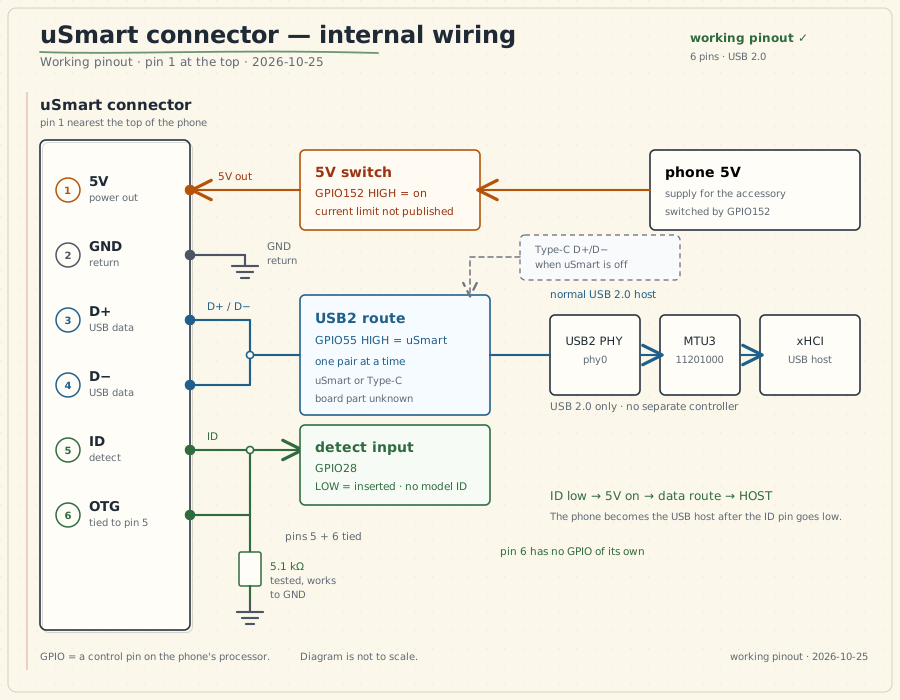
The three controls are simple:
- GPIO152 turns the 5V pin on and off.
- GPIO55 selects the uSmart USB pair instead of the Type-C pair.
- GPIO28 watches the ID pin and tells the phone when something is plugged in.
What happens when you plug it in
- The accessory pulls the ID pin low through the 5.1 kΩ resistor.
- GPIO28 sees the low level and tells the phone an accessory is present.
- The phone switches on 5V with GPIO152.
- The phone connects its USB 2.0 pair to uSmart with GPIO55.
- The phone becomes the host and looks for a USB device.
Unplugging reverses the order: 5V goes off, the data pair goes back to Type-C, and the phone drops the host role.
The phone doesn’t ask what the accessory is before it powers the port. It just sees the ID pin go low. That’s why the wiring has to be right before you plug anything in.
Power
Pin 1 gives you 5V from the phone. The current limit isn’t published, so treat uSmart as a small auxiliary supply, not a power bank.
- Start with a low-power device.
- Measure the current before connecting a motor, radio, lamp or anything else hungry.
- Don’t feed 5V into pin 1.
- Don’t assume it can supply 500 mA, 1.8 A or any other number.
- The Type-C charger ratings don’t apply to uSmart.
- There’s no evidence that uSmart can charge the phone or reverse-charge another device.
Ulefone says Type-C charging can continue while a uSmart accessory is attached. That’s plausible because the power paths are separate, but there’s no test here that runs Type-C data and uSmart data at the same time.
What you can connect
The phone is the host. The accessory must be a USB device, not another host.
| Device type | What to expect |
|---|---|
| UVC camera or endoscope | Best supported. The stock app includes a generic UVC path. |
| USB audio | A standard device may work. The H01 headset is not proven on this phone. |
| Keyboard or mouse | A standard HID device may work. There is no built-in uSmart UI for it. |
| USB serial adapter | May work if Android has a driver or the app provides one. |
| USB storage | May work, but the stock app’s storage path is not fully mapped. |
| USB 3.0, DisplayPort or HDMI | Not supported through uSmart. |
| Analog audio | No analog audio path was found. |
| High-power accessories | Wait until the 5V current limit is measured. |
A USB hub is untested. It also adds another device and more power draw, so keep the setup simple.
Official uSmart accessories
These are Ulefone products, not independent test results:
| Accessory | What it is | Status on this phone |
|---|---|---|
| uSmart E01 | Endoscope | Listed for Armor 29 |
| uSmart E02 | Dual-camera endoscope | Listed for Armor 29 |
| uSmart E03 | Articulating endoscope | Listed for Armor 29 |
| uSmart C01 | Microscope | Listed for Armor 29 |
| uSmart H01 | Earphone, microphone and PTT | Not listed for Armor 29; compatibility unconfirmed |
“Listed” means Ulefone says it works. It does not mean every feature has been tested on this exact phone.
uSmart and USB-C
They’re separate ports with different jobs.
| uSmart | USB-C | |
|---|---|---|
| Pins | 6 | 24 |
| Data | USB 2.0 | USB 2.0, USB 3.x, DisplayPort and other modes |
| Power | 5V out to an accessory | Charging, USB-PD and source/sink roles |
| Reversible | No | Yes |
| Same time as the other port? | Charging is claimed; simultaneous data is not proven | — |
uSmart doesn’t use USB-C CC, SBU or USB-PD signalling. Don’t treat it like a USB-C receptacle.
Making your own accessory
Start with a normal USB 2.0 device. The phone is the host, so don’t try to connect another host.
- Connect 5V, GND, D+ and D−.
- Tie pins 5 and 6 to ground through a 5.1 kΩ resistor.
- Keep the 5V current low until the limit is measured.
- Add ESD protection and inrush limiting.
- Do not backfeed power into the phone.
- If the accessory has its own power supply, leave pin 1 disconnected.
Don’t connect a charger to the 5V pin. It’s an output from the phone, not a charging input. A UVC camera or a USB serial adapter is a safer first project than a motor or a radio.
What’s known, and what isn’t
| Solid | Not documented |
|---|---|
| Six pins: 5V, GND, D+, D−, ID and OTG | Maximum current on the 5V pin |
| The 5.1 kΩ detect connection works | Official Ulefone pinout drawing |
| The phone switches 5V on when ID goes low | Exact role of each of the two ID pins |
| The phone switches its USB 2.0 pair to uSmart | USB descriptors of the official accessories |
| The phone becomes a USB host | Simultaneous Type-C data and uSmart data |
| No model ID or authentication | Connector part number and mating plug |
| UVC cameras are the best-supported accessory | — |
The pin order is a working pinout, not a stock-firmware finding. It’s the order that has been tested with the 5.1 kΩ resistor.
For kernel people
The three controls are:
| Control | Job |
|---|---|
Detect input (GPIO28) | Reads the ID pin |
Power switch (GPIO152) | Turns the 5V pin on and off |
Data switch (GPIO55) | Connects the USB 2.0 pair to uSmart or Type-C |
Everything after the switch is the phone’s normal Linux USB host stack. There is no separate uSmart controller.
uvc_insert_status = 1 only means the ID pin is low. It does not mean a camera is
streaming or that the phone has recognized a USB device.
Where this comes from
This page is a simpler version of the LieppOS uSmart research. The full evidence is in the research repository.
- uSmart research snapshot
- Hardware contract
- Power path
- USB routing
- Accessory support
- Community uSmart adapter pinout
- Ulefone 19T uSmart notes
- Ulefone Armor 29 Pro Thermal
- Ulefone uSmart H01
Last updated: 2026-10-25.
Kernel architecture
The LieppOS kernel is the Android Common Kernel android14-6.1 (ACK 6b18f0b574ab, GKI
12901745) merged with the MediaTek MT6878 device-kernel sources and the GQ5012BF1 board
configuration, built as one tree with CONFIG_MODVERSIONS, KCFI and strict modpost.
kernel/ulefone/gq5012bf1            board kernel: GKI core + MediaTek drivers + board defconfig + DTS
vendor/mediatek/kernel_modules/*    out-of-tree vendor modules, rebuilt against the same kernel output
Every module — in-tree and external — is built against one kernel identity: the same
Module.symvers, generated headers and release string. The build engine refuses to mix modules
from different builds, refuses modpost warnings, and never edits CRCs or vermagic.
Release identities
| Target | Kernel release |
|---|---|
| dev21 | 6.1.115-mt6878-gq5012bf1-dev21+ |
| dev21 + performance | 6.1.115-mt6878-gq5012bf1-dev21-perf1+ |
| C26 (packaged) | 6.1.115-mt6878-gq5012bf1-c26+ |
Mixed-tree providers
Two in-tree modules (mtk-vmm-isp71-regulator, mtk-mmdvfs-ccu) import symbols exported by the
external camera module mtk_ccuv.ko. The build follows the owner recipe: build the kernel, run a
strict bootstrap modpost over every other module, build the provider, then run the final strict
modpost with KBUILD_MIXED_TREE holding the kernel exports plus the provider exports.
No CRC is synthesized.
Module signing
CONFIG_MODULE_SIG=y and CONFIG_MODULE_SIG_PROTECT=y are set. Under the GKI rules an unsigned
module cannot export any of the 349 protected exports. The packaged DLKM modules are therefore
signed with the development key named by CONFIG_MODULE_SIG_KEY, whose certificate is embedded
in the kernel Image. See DLKM partitions.
What this does not prove
An offline build of a closed, signed module set is not a boot. ufs-mediatek-mod is
source-divergent and is the critical runtime gate; see Boot chain.
Source layout
| Path in the kernel repository | Content |
|---|---|
arch/arm64/configs/gq5012bf1_defconfig | complete board configuration (equals the effective .config) |
arch/arm64/boot/dts/mediatek/mt6878.dts | platform DTS |
arch/arm64/boot/dts/mediatek/gq5012bf1-board.dts | trusted board overlay (independently authenticated compatibles only) |
arch/arm64/boot/dts/mediatek/gq5012bf1-board-pending.dts | provenance-pending board data; compiled only by an explicit experimental policy and behind CONFIG_GQ5012BF1_PENDING_BOARD_DT (default n) |
arch/arm64/boot/dts/mediatek/k6878v1_64.dts | MediaTek reference-board overlay (comparison only) |
drivers/misc/mediatek/... | MediaTek platform drivers |
LIEPPOS-*.md | per-campaign handoffs, ledgers and provenance |
The kernel defconfig and the hardware DTS live in the kernel repository, never in the Android device tree. Android init, SELinux, VINTF, vendor extraction, product and boot-packaging configuration stay in the device repository.
Toolchain
Android clang/LLD 17.0.2 (clang-r487747c), with recorded binary hashes. pahole 1.32 for BTF.
Building the kernel
Supported path: the LieppOS build engine
The engine (tools/lieppos-build) materializes the pinned sources, builds in an out-of-tree root
on an ext4 volume, rebuilds every external module against the same output, enforces strict
modpost, and writes an immutable artifact set with a build receipt.
cd tools/lieppos-build/scripts
# check every pinned input of the target
./lieppos-kernel --root <engine-root> source verify --target gq5012bf1-mt6878-dev21
# detached, gated build
python3 kernel-workspace/tools/lieppos-build-controller.py --root <engine-root> \
    --target gq5012bf1-mt6878-dev21 --profile c21-parity --tag <tag> --jobs 32
# trusted device tree, then the receipt + artifact set
./lieppos-kernel --root <engine-root> boot dt-declared --target gq5012bf1-mt6878-dev21 --profile c21-parity --dt-policy trusted > dt.json
python3 kernel-workspace/tools/lieppos-receipt.py --engine-root <engine-root> --target gq5012bf1-mt6878-dev21 \
    --profile c21-parity --dt-log dt.json --dest <output-root>
Targets: gq5012bf1-mt6878-dev21 (owner source and config exactly) and
gq5012bf1-mt6878-dev21-performance (with the FPSGO/C2PS integration, release -dev21-perf1).
Plain Kbuild (for reading, not the release path)
make -C kernel/ulefone/gq5012bf1 O=<out> ARCH=arm64 LLVM=1 LLVM_IAS=1 gq5012bf1_defconfig
make -C kernel/ulefone/gq5012bf1 O=<out> ARCH=arm64 LLVM=1 LLVM_IAS=1 MTK_PLATFORM=mt6878 Image
make modules alone stops in modpost on the two CCU consumers; that is expected and resolved by
the mixed-tree recipe (Architecture).
Warning — do not run:
dk12/build-image.sh,dk12/make-device-tree.shanddk12/build-vendor-targetC.shin the historical workspace are not build entry points. The first two erase kernel source; the third erases a historical vendor module tree. All three are guarded to refuse execution.
Reproducibility
Engine dev21 build (f7f5ae92572ca86d) vs the independent C21 build:
| Artifact | Result |
|---|---|
.config, kernel release, vmlinux.symvers, mixed-tree export table, modules.builtin(.modinfo) | byte-identical |
Module.symvers (19,759 exports) | byte-identical |
2,741 objects in vmlinux.a | 5 byte-identical; 2,732 match after stripping debug/comment/addrsig; 4 still differ |
Image / vmlinux | not byte-identical: temporary version banner, initramfs cpio timestamps and vDSO build-ids differ |
| 732 of 740 same-named modules | identical after removing debug info, comment, addrsig and build-id |
| 8 modules | still differ after stripping; complete binary equivalence is not certified |
No dev21 byte-for-byte reproducibility claim is made. Historical Phase 11 C18 incremental and from-scratch builds were byte-identical; that does not automatically certify dev21 or the performance integration.
Storage safety
- Btrfs metadata hard floor: 4 GiB; heavy-build restart threshold: 6 GiB.
- General free-space floor: 25 GiB, including projected post-operation use.
- Filesystem error counters must remain zero.
- One owner and one live controller per mutable output directory.
External modules
33 modules come from five vendor repositories built out of tree (M=) against the kernel output:
| Repository | Modules |
|---|---|
Mali (mali) | 4 (mali_kbase_mt6878_r44, memory group manager, protected allocator, DMA-buf test exporter) |
camera (mtkcam) | camsys (4), CCU mtk_ccuv, DPE, cam_cal |
imgsensor (nested in mtkcam) | 2 |
| connectivity | conninfra, connfem, WLAN adaptor + core, BT, GPS (3), FM |
| MET | 11 (met + API modules) |
Rules
- Each tree is pinned by commit and tree id.
- Provider symbol tables come only from modules built in the same run.
- Duplicate exports and undefined symbols fail the build.
- The Mali recipe follows the owner’s
build-mali-r44.shexactly. - Test and helper modules (
cam-ut,kheaders, the DMA-buf test exporter) are reported separately and never autoloaded.
Firmware
Mali firmware (mali_csffw.bin) and connectivity firmware are stock binaries and are not in
source. They are never redistributed by LieppOS.
See DLKM partitions for how these modules are packaged and signed.
Device tree
| File | Trust | Packaged |
|---|---|---|
mt6878.dtb | platform base, trusted | yes |
gq5012bf1-board.dtbo | trusted board overlay | yes |
gq5012bf1-board-pending.dtbo | provenance pending | never (experimental policy only) |
k6878v1_64.dtbo | MediaTek reference board | comparison only |
Pending GPIO, regulator, bus, charging and display values are not enabled to make the tree look complete. The trusted description is incomplete, which is one of the boot gates.
The engine’s dev21 DTB and trusted DTBO are byte-identical to the C21 build (b3250992…,
e9896d33…).
DTBO partition
The DTBO partition image is a separate artifact from the DTBs the kernel build emits. The
device-scaffold DTBO table layout, IDs and stock contract still need verification; the boot
package ships the stock dtbo.img (9092967872d1362c45a18d62a83360b742eed58aafa4b0c15043ef159ae042d3)
unchanged.
Compiling a DTBO is not the same as the bootloader accepting the overlay table. See AVB and trust.
Performance (FPSGO/C2PS)
VERIFIED OFFLINE — acceptance HOLD. No runtime scheduling or boot claim is made.
The FPSGO/C2PS performance cohort is maintained in its own repository and integrated into the
kernel on a separate integration branch (lieppos/dev21-performance-integration):
- a subtree merge of the performance repository at
drivers/misc/mediatek/performance/lieppos14(its history is the merge’s second parent; update only by merging a newer commit); - seven reviewed kernel commits, one per native overlay: native output owners, sugov control lease, scheduler uclamp lease, ADPF contract, CPUQoS task lease, ADPF ratio lease, ADPF session lease.
Build result
Release 6.1.115-mt6878-gq5012bf1-dev21-perf1+: strict modpost passes; 744 modules = dev21’s
741 + fpsgo.ko, mtk_c2ps.ko, c2ps_perf_ioctl.ko.
The historical Codex 12-module selected cohort is present as 9 replacements of existing filenames plus 3 additions, not 12 new modules.
New kernel exports: sched_uclamp_lease_{acquire,apply,is_live,release}. No existing kernel CRC
changed.
Acceptance: HOLD
An offline build proves neither runtime scheduling safety nor bootability. Promotion requires
lockdep, KCSAN and hardware validation. Research revisions: integration/c24-codex17
(b8463cc1) and integration/c25 (42e32526).
FBT lifecycle (C25)
C25 recreated the FBT policy and fixed suspend/resume and UX EAS ownership, with a focused rebuild and first-stage UFS intake. These are source-level corrections; runtime effects are untested.
Android 16 GSI
The GSI checkout is LineageOS 23.2 / Android 16 with TrebleDroid, product tdgsi_arm64_ab. It is
not a GQ5012BF1 full-device checkout and it uses the stock kernel and vendor contract.
Pinned graph
The committed project graph is captured by gsi/lineage-23.2-gsi-pinned.xml (1,172 projects);
gsi/lieppos-gsi-overlay.xml separately pins vendor/lieppos.
Owner changes in scripts, lieppos.mk, a personal patch and the local manifest were preserved —
not applied, not reverted. A committed manifest does not reproduce those dirty changes
automatically.
Rules
- Do not add the full-device kernel/module manifest to this checkout.
- Do not run
repo syncover the preserved dirty state. - The GSI’s
vendor/liepposcustomization is not the device’s proprietary vendor tree (Vendor integration).
See Manifests for the separate full-device graph.
A booting GSI proves that stock kernel + vendor support a generic system image. It does not validate the LieppOS kernel.
Full-device Android ROM
The device repository at device/ulefone/gq5012bf1 is an Android 15 / LineageOS 22.2-era scaffold. It is not an Android 16 device port.
Default remains stock
Its default is TARGET_PREBUILT_KERNEL := $(DEVICE_PATH)/prebuilt/kernel with BOARD_KERNEL_IMAGE_NAME := Image.lz4, plus the stock DTB and DTBO. Campaign 23 did not replace those files.
The experimental kernel profile
An isolated development branch adds LIEPPOS_KERNEL_PROFILE=dev21-experimental. It requires LIEPPOS_KERNEL_ARTIFACTS and refuses configuration unless all artifact and boot gates pass. Today the mandatory manual boot gates remain blocked; artifact-local JSON assertions cannot authorize deployment.
Responsibility split
| Belongs to | Content |
|---|---|
| kernel repository | defconfig and hardware DTS |
| device repository | Android init, SELinux, VINTF, vendor extraction, product and boot packaging |
Status
No full-device ROM build or boot has been performed. Android 15 remains the first custom-kernel integration baseline; migration to Android 16 is a separate task and the two are never combined in one checkout.
A device tree that configures cleanly is not a ROM that boots. See Boot chain and Vendor integration.
Android boot chain: independent gates
An offline kernel build does not establish Android bootability. Each layer below is a separate check with its own evidence class.
| Layer | Verified or missing |
|---|---|
Raw ARM64 Image | source-built (C23/C26) |
Image.lz4 | LZ4 legacy framing and decompression roundtrip verified; follows Kbuild’s lz4 -l -12 --favor-decSpeed |
| boot header | device scaffold records stock header v4; not independently validated as a new boot image |
| platform DTB / trusted overlay | source-built, hashes equal the C21 evidence |
| DTBO partition image | not produced; table layout, IDs and stock contract remain to be verified (stock dtbo.img shipped unchanged) |
| vendor ramdisk | authorized vendor_boot, modules.load, first-stage placement and bootconfig missing |
| trusted board description | incomplete; pending wiring stays disabled |
| AVB | project keys and a verified chain absent; see AVB and trust |
| module signing | packaged modules signed with the development key; runtime acceptance unverified |
| hardware | not tested |
UFS first-stage dependency requirement
CONFIG_SCSI_UFSHCD=y and platform glue are built in, but the MediaTek host is
ufs-mediatek-mod.ko. Its built-module dependency closure, ordered before the consumer, is:
aee_aed -> irq-dbg -> mrdump -> ufs-mediatek-dbg -> blocktag -> rpmb -> ufs-mediatek-mod
This is one valid topological order, not an authenticated modules.load list. The seven
modules exist with matching vermagic. Without authorized vendor-ramdisk evidence their early
availability and placement remain UNKNOWN. A module only present in later vendor_dlkm
cannot be assumed available before UFS is mounted.
Three-stage module load order
| Order | Stage | Mechanism | Mount point |
|---|---|---|---|
| 1 | vendor_boot platform ramdisk | first-stage init / libmodprobe | ramdisk |
| 2 | system_dlkm | init.insmod.sh loop, first entry | /system_dlkm/lib/modules |
| 3 | vendor_dlkm | same loop, second entry | /vendor_dlkm/lib/modules |
| 4 | init triggers | insmod / modprobe -a -d in vendor rc files | after post-fs-data / boot |
system_dlkm must load before vendor_dlkm: vendor_dlkm’s bluetooth, cfg80211 and
mac80211 consume rfkill symbols exported by system_dlkm. Details in DLKM partitions.
What is still separate
Link closure, first-stage placement and runtime behaviour are three different checks. Closing
rpmb’s symbols does not reconstruct stock RPMB transfer-sizing behaviour, and a closed module
set does not prove Android starts.
Hazard: do not treat this chain as a flashing procedure. See Boot package for why the current package is not deployable.
Boot package
VERIFIED OFFLINE. NOT DEPLOYABLE. C28 verdict: OFFLINE_PREFLIGHT_FAILED.
Research: DOCS/restructuring/c27/LIEPPOS-C27-BOOT-PACKAGE.md, C28 delivery
receipt and C28-PACKAGE-VALIDATION.md @ ae6dce06.
Packages
| C27 | C28 | |
|---|---|---|
| Package id | c27-20261025 | c28-20261026 |
| Kernel | 6.1.115-mt6878-gq5012bf1-c26+ | unchanged |
vendor_boot | — | 4d737a96… |
vendor_dlkm | 80a2e9cc… | 4f100bb3… |
system_dlkm | d3c6ae6d… | 87ae805d… |
vbmeta | b5a14204… | 39021ec7… |
Module inventory: vendor_boot 195, system_dlkm 60, vendor_dlkm 215.
Offline gate table (C28)
| Gate | Status |
|---|---|
| Kernel build | PASS (C26, checksums re-verified) |
| Full module closure | PASS (469/469 loadable, 0 unresolved, 0 CRC mismatch) |
| First-stage UFS | PASS_OFFLINE (stock list order; ufs-mediatek-mod source-divergent) |
| Vendor DLKM | PASS |
| System DLKM contract | PASS |
| Effective board DT | PASS_OFFLINE |
| Display / MML | PASS_OFFLINE |
| HBT driver | PASS_OFFLINE |
| AVB descriptor integrity | PASS (13/13 bindings) |
| Partition-size compatibility | PASS (all images fit) |
| Slot-B userspace compatibility | FAIL |
| Bootloader trust acceptance | UNVERIFIED |
| Google GKI signature acceptance | UNVERIFIED |
| Recovery readiness | PASS_OFFLINE (shared-state capture still required) |
| Hardware boot | NOT TESTED |
| Runtime acceptance | HOLD |
Why it failed preflight
- Slot-B userspace. The bound stock Android 15 userspace needs 4,948.9 MiB;
Slot B holds 2,173.7 MiB (3,664.7 MiB without
scratch). Fixing this means shrinking Slot-A logical partitions — an owner decision. - Current Slot-B content. The Android 17 experiment conflicts with the C28
root (chain keys, hashtrees) and its
vendor_blacks the second-stage fstab.
Independent verification
C28 package: PASS (49/49 checks). C27 negative control: FAIL (14), confirming the verifier detects the defects C28 fixed.
What a passing offline package still does not mean
Descriptor integrity, module closure and image-size arithmetic are offline properties. None of them establishes that the bootloader accepts the images or that Android starts.
Hazard: this package is not flash-ready. See AVB and trust.
Related
- Boot chain · DLKM · Partitions
DLKM partitions
VERIFIED OFFLINE. Not booted. No module has been loaded on hardware.
Research: DOCS/restructuring/c27/LIEPPOS-C27-{VENDOR,SYSTEM}-DLKM.md,
C28-SYSTEM-DLKM-CONTRACT.md, docs/module-map.md @ ae6dce06.
Contract
| Partition | Modules | Image size |
|---|---|---|
vendor_boot (platform ramdisk) | 195 | 64 MiB partition |
system_dlkm | 60 | 7,471,104 B EROFS |
vendor_dlkm | 215 | 17,534,976 B EROFS |
How the counts relate
These numbers are different measurements, not contradictions:
| Figure | Meaning |
|---|---|
| 457 | unique stock module identities |
| 471 | stock partition occurrences = 457 + 14 duplicates |
| 456 | identities rebuilt loadable (hbt.ko, gzvm.ko recovered in C27) |
| 1 | built-in: timer-mediatek (CONFIG_MTK_TIMER=y), .ko deliberately not shipped |
| 470 | shipped occurrences = 195 + 60 + 215 (= 471 − 1) |
| 469 | loadable: vendor_dlkm/bluetooth.ko is shadowed by the signed system_dlkm copy, as on stock |
The 14 duplicates are stock behaviour: 13 modules ship in both vendor_boot and
vendor_dlkm (reboot-mode, syscon-reboot-mode, spmi-mtk-mpu, the three
mtk_*_throttling modules, mtk_pbm, mtk_mdpm, mtk_rpmsg_mbox, mtk-mbox,
mtk_tinysys_ipi, mtk-mmdvfs-v3-start, yft_devinfo), plus bluetooth.ko in
both vendor_dlkm and system_dlkm.
C28 fixes that made the package coherent
- GKI module signatures. The C26 kernel sets
CONFIG_MODULE_SIG_PROTECT=y. C27 shipped all 60 GKI modules unsigned; 25 export protected symbols, leaving 58 unloadable (incl.cfg80211,mac80211,wlan_drv_gen4m_6878,bt_drv_6878,bluetooth). C28 signed them with the C26 kernel’s own module key. Stock signs 60/60. - SELinux labels. C27 images carried no xattrs, so 299 inodes were
unlabeledandinit_insmod_shmodule_loadwas denied (neverallow). Fixed withmkfs.erofs --file-contextsusing the AOSP lines. system_dlkmetc/. Stocketc/(4 files) and the stock UUID restored.
Load closure
195 / 60 / 215, 470 occurrences, 0 unresolved, 0 CRC mismatch, 0 duplicate
exports. First-stage UFS order is the stock list minus the now-built-in
timer-mediatek:
aee_aed -> irq-dbg -> mrdump -> ufs-mediatek-dbg -> blocktag -> rpmb -> ufs-mediatek-mod
This is one valid topological order, not an authenticated modules.load.
Placement before UFS mounts stays UNKNOWN without an authorized vendor_boot
ramdisk.
Unplaced modules (C28 review)
205 built modules are not shipped, classified as: 97 unused (evidenced), 87 unknown (no OF binding; userspace use cannot be excluded offline), 9 optional (stock ships no provider), 8 incompatible (other SoCs), 4 test-only. Required: 0. Placement changes: 0. Binding an optional pump-express algorithm would change charging current and needs owner and hardware evidence.
What this does not prove
Closure and ordering do not prove Android boot, verity bring-up, or that any
driver binds. ufs-mediatek-mod is source-divergent and is the critical runtime
gate.
Related
AVB and trust boundaries
VERIFIED OFFLINE (descriptor integrity) · UNVERIFIED (bootloader acceptance).
Research: DOCS/restructuring/c28/C28-AVB-TRUST-MODEL.md,
C28-BOOTLOADER-ACCEPTANCE-GATES.md, LIEPPOS-C28-AVB-TRUST.md @ ae6dce06.
Six mechanisms that are easy to conflate
| # | Mechanism | Status |
|---|---|---|
| 1 | AVB root trust | Factory root is signed with the public AOSP testkey_rsa2048 (cdbb7717…). The C28 root uses the same key, so the root-trust relationship is identical to stock |
| 2 | OEM boot chain | Key 9d808b09… signs the stock boot footer. Not reproduced. C28 binds boot with a root hash descriptor over the C26 image instead of the location-3 chain |
| 3 | Boot-image signature metadata | Stock boot.img is header v4 with signature_size = 0, so it has no v4 signature block. The earlier claim that the footer is a confirmed Google GKI key is superseded: it cannot be confirmed from the images |
| 4 | Kernel module signing | 60 GKI modules signed with the C26 kernel’s own module key, whose certificate is embedded in the C26 Image (see DLKM) |
| 5 | dm-verity | Hashtrees present for system, system_ext, product, odm_dlkm, system_dlkm, vendor_dlkm; bring-up on hardware unverified |
| 6 | Bootloader acceptance | UNVERIFIED. No gate was exercised |
A successful AVB verification with a development key is not proof of bootloader acceptance. AVB and the GKI boot-signature mechanism are independent; neither replaces the other.
Observed, not guaranteed
- Stock boots with a root signed by the AOSP test key; the live Slot-A root has
flags = 3and an invalid signature, yet boots — the bootloader appears unlocked or permissive. - Slot-B root
a9d8cd21…(experiment keyd6b1afef…) reached Android 17 second-stage init on 2026-10-03, so LK accepted a non-stock root key.
Hardware gates (all open)
| # | Gate | Pass criterion |
|---|---|---|
| G1 | Lock state | ro.boot.verifiedbootstate, ro.boot.vbmeta.device_state |
| G2 | Root with flags = 0 | LK reaches kernel; /proc/pl_lk, pstore |
| G3 | boot as root hash descriptor | LK does not require the OEM chain |
| G4 | GKI boot signature | not required (signature_size = 0) |
| G5 | Rollback | stored indexes 0/2/4 ≤ 0; location 3 unreferenced |
| G6 | Module signing | no -EACCES for the 60 GKI modules |
| G7 | dm-verity | system_dlkm / vendor_dlkm verity devices appear |
| G8 | First-stage UFS | ufs-mediatek-mod probes, super appears |
None exercised. Hardware validation: 0.
Rollback
Every C28 rollback index is 0, matching the factory values for locations 0, 2 and 4. Location 3 (boot chain) is no longer referenced. Device-stored rollback values were not captured offline.
Hazard: do not flash a Slot-B package to a production device. The bound stock Android 15 userspace needs 4,948.9 MiB; Slot B offers 2,173.7 MiB. The verdict is
OFFLINE_PREFLIGHT_FAILED.
Related
Android 17 Slot-B experiment
EXPERIMENTAL · UNVERIFIED · UNSUPPORTED. Not a LieppOS product.
Research: android17-hidl-fixed-build-20261002/ (86 artifacts, 2026-10-02/03),
DOCS/restructuring/c28/C28-SLOT-B-COMPATIBILITY.md @ ae6dce06.
Android 17 was exercised only as Slot-B content for bring-up forensics. It was never a LieppOS-supported configuration, and it is not on the roadmap.
What the artifacts record
- An
init_bootreconstruction with two device-tree patch revisions and a generic-ramdisk variant. - A first-stage mount contract, followed by a series of first-boot failures:
metadata fix,
dmresolution,vendor_bboundary proof, zygote/adbd service resolution, logo hang, and static audits. - A Slot-B first-boot activation record and a live B bootmode capture.
What was actually achieved
| Claim | Status |
|---|---|
| A17 Slot-B reached second-stage init on 2026-10-03 | VERIFIED ON DEVICE (historical) |
| A17 boots to a usable Android interface | UNVERIFIED — no such result exists |
| A17 is supported by LieppOS | NO |
Reaching second-stage init means early userspace started. It does not establish a working framework, display, radio, or any user-visible function.
Why it blocks C28
The current Slot-B A17 content conflicts with the C28 root: chain keys and
hashtrees differ, and its vendor_b lacks the second-stage fstab. It is one of the
two stated C28 blockers.
Campaign status
C29 (011b9224) and C32 (cf36c62a) are Android 17 Slot-B forensics only, both
ANDROID17_OFFLINE_PREFLIGHT_FAILED. C32 resolved SELinux root-cause localisation,
MediaTek AEE contract recovery, framework provenance and linker namespaces; 2 offline
gates remain (strict SELinux cross-version compatibility and framework reproducible
rebuild). Neither campaign changed Android 17’s status: it is experimental,
off-roadmap, and never booted to a usable interface.
Android 15 remains the first custom-kernel integration baseline.
Related
Vendor integration
android_vendor_ulefone_gq5012bf1 is planned, not an available published repository. The device scaffold’s extraction scripts and proprietary-files.txt describe its inputs; they do not grant redistribution rights.
The source manifest leaves this vendor project out until authorized extraction, provenance and licensing review are complete. Firmware, secure-world binaries and proprietary HALs are not copied into new public source candidates or into this book.
Requirements before a full ROM can be accepted
- matching vendor/odm HAL and VINTF manifests;
- init service, uevent and SELinux policy relationships;
- first-stage kernel-module placement and load order;
- verified bootconfig and AVB chain;
- an actual full-device Android build and independently authorized boot validation.
The Android 16 GSI’s separate vendor/lieppos customization is not the device’s proprietary vendor tree.
Declared interfaces (HAL entries, VINTF manifests, SELinux types) are static facts. They are not evidence that a service runs. See Understanding evidence.
Getting started
- Read Current status, Provenance and the Build environment.
- Choose either the Android 16 GSI or the Android 15 full-device workflow; never combine their manifests.
- Use a new authorized workspace. Do not overwrite historical outputs or synchronize over dirty owner work.
- Validate the source lock and local source graph before compiling.
- Read the build receipt and acceptance boundaries before interpreting a successful build.
The local manifest repository is android_manifest_lieppos; until publication is authorized, use its local.xml against the preserved local candidates. Manifests lists the tested commands.
Destructive scripts — do not run
dk12/build-image.sh, make-device-tree.sh and build-vendor-targetC.sh are destructive reconstruction scripts, not build entry points. Their guards deliberately refuse execution. Use the LieppOS build engine instead.
Building is not booting. Nothing here produces a deployable image.
Pinned manifests
All LieppOS source projects are pinned by full Git SHA with an explicit upstream branch. Nested imgsensor is a separate project at vendor/mediatek/kernel_modules/mtkcam/imgsensor/src-v4l2; the parent tracks no files there and ignores the nested checkout.
| Manifest | Scope |
|---|---|
local.xml | local kernel, external modules, tools, device and recovery candidates |
default.xml | intended publication graph; unavailable remotes are explicitly recorded |
lineage-22.2/gq5012bf1.xml | Android 15 full-device local-manifest snippet, not a complete Android base |
gsi/lineage-23.2-gsi-pinned.xml | existing Android 16 GSI snapshot |
gsi/lieppos-gsi-overlay.xml | separate committed LieppOS GSI vendor pin |
Tested local checkout (new empty directory only)
repo init -u file:///path/to/android_manifest_lieppos \
  -b main -m local.xml \
  --repo-url file:///path/to/repo \
  --repo-rev <pinned-tag> \
  --no-repo-verify --no-clone-bundle
repo sync -c -j4 --no-clone-bundle
Use only a new empty directory. The offline repo-tool revision must be pinned to an existing local tag; signature verification is unavailable in a local-tool test, which is not the same as disabling it for a future public setup.
What was actually verified
Ten projects synced at their pins and passed Git connectivity checks. The kernel manifest needs an explicit clone-depth to preserve the server’s shallow boundary; without it the first checkout had a missing-parent error. The missing ACK ancestry was not fabricated.
A full-device LineageOS base snapshot is still unavailable: the snippet is not a claim that the entire Android 15 source graph is pinned. No GitHub sync success is claimed for unpublished repositories.
Build environment and output ownership
Kernel source and build outputs are separate. Heavy builds use authorized isolated ext4 output directories, never the original dev21 or Codex output trees.
Safety gates
| Gate | Value |
|---|---|
| Btrfs metadata hard floor | 4 GiB |
| Conservative Btrfs heavy-build restart threshold | 6 GiB |
| General free-space floor | 25 GiB, including projected post-operation use |
| Filesystem error counters | must remain zero |
| Mutable output directory | one owner, one live controller |
Output layout
Future immutable outputs live under $BUILD_ROOT/gq5012bf1/kernel/<line>/<build-id>/. $BUILD_ROOT is a maintainer-local path variable; the concrete host location is deliberately not published.
Each receipt records: source commits, declared overlays, effective config, compiler identity, build invocation, module hashes/classification, DT hashes and offline verification status. Historical output directories are not moved.
Toolchain
Android clang/LLD 17.0.2 (clang-r487747c), with recorded binary hashes; pahole 1.32.
Documentation tooling
mdBook builds this site from src/. Editing requires adding a page and a SUMMARY.md entry. No global package installation is needed for the research work described here.
Contributing
- Keep kernel, external modules, Android device configuration, recovery, research and documentation responsibilities separate.
- Preserve Git history. Work on isolated branches; never reset another agent’s branch, squash the source import or clean unknown generated evidence.
- Make production changes in their owning source repository. Integration branches carry reviewed native kernel changes; the build engine must not grow a competing production-source copy.
- Pin dependencies and include genuine source-built ABI evidence. Never borrow old
.kofiles, fake CRCs, weaken modpost or infer runtime correctness from symbol closure. - Keep trusted board facts separate from pending numeric wiring. Every hardware claim needs an authorized evidence citation.
- Document unknowns explicitly and preserve certification counts: strict 440/458, experimental 6/458, hardware 0.
- GitHub publication, signing/deployment changes and all phone operations require separate owner authorization.
Documentation changes
Edit src/ and update src/SUMMARY.md for every new page. Keep the evidence labels described in Understanding evidence. Do not add binary evidence or links claiming that planned repositories already exist.
Research belongs in the research repository; this site is a curated explanation of it. Do not copy raw campaign reports or logs into the book.
Engineering methodology
Research distinguishes authentic stock behaviour, available source, reconstructed source, offline build results and hardware evidence. These are different evidence classes, not interchangeable success labels. See Understanding evidence.
What a valid result needs
A valid build result needs a committed source graph, declared non-Git inputs, effective configuration, compiler identity, generated headers, strict modpost and a complete module manifest.
A valid runtime claim additionally needs independently authorized runtime validation.
| Claim type | Sufficient evidence |
|---|---|
| “It builds” | source lock + config + toolchain + strict modpost + module manifest |
| “It is ABI-closed” | Module.symvers, CRCs, dependency graph per partition |
| “The descriptor is valid” | authenticated image + recomputed hashtree + root binding |
| “It boots” | hardware observation only |
| “The driver works” | hardware observation only |
History is immutable
Historical logs and hashes remain immutable. Corrections are appended, or made on a new review branch with clear provenance; they do not rewrite canonical research master.
The curated book explains the result. The research repository holds the raw evidence and detailed limitations.
Source provenance and publication limits
Owner review required before publication. This page describes licensing boundaries; it does not grant any redistribution right.
Kernel history
The board kernel history is shallow at ACK 6b18f0b574ab3267615ae6ce642d5a7c3c21ac09. All local development commits and dev15–dev21 branches are preserved outside the original directory by an exact Git metadata copy and a Git-native mirror. Neither mechanism invents missing upstream ancestry. A bundle alone is not treated as a faithful shallow backup.
MediaTek / NothingOSS source
Integrated by path in the recorded import. Kernel and vendor notices require review before publication. In particular:
- the imported kernel contains a donor module-signing private key — it must never become a real LieppOS release key;
- Mali and connectivity contain confidential/proprietary-marked files;
- MET lacks a complete vendor Git provenance chain;
- the Codex wrapper includes proprietary-marked source and stays private;
- stock firmware, vendor blobs and secure-world binaries have separate redistribution boundaries.
Known non-Git input
The focaltech firmware include is still absent from the dev21 Git commit because *.i is ignored. The build engine restores a declared, hash-pinned historical input; the build is therefore not claimed to be wholly reconstructible from Git alone.
Website policy
This site reproduces no firmware, no extracted vendor binaries, no private signing material, no credentials, no device-unique calibration and no raw logs. Key material appears only as SHA-1/SHA-256 identifiers.
Public source candidates are prepared locally, not published. Owner license review and publication authorization remain mandatory.
Evidence index
Canonical repository: LieppOS/LieppOS-ulefone-gq5012bf1-research. Do not create a second similarly named repository.
Documentation source revision: ae6dce06 (Campaign 28, 2026-10-26).
Branch situation
master is 23 commits behind the newest integration line. C23–C29 and C32 are on integration/* branches and are not merged into master.
integration/c28-slot-b-readiness—ae6dce06, the baseline this book documents.integration/c29-android17—011b9224, Android 17 Slot-B integration (ANDROID17_OFFLINE_PREFLIGHT_FAILED).integration/c32-android17—cf36c62a, Android 17 gate resolution; 2 offline gates remain (ANDROID17_OFFLINE_PREFLIGHT_FAILED).
Campaigns 29 and 32 are Android 17 Slot-B forensics only; they are not on the LieppOS roadmap and their images were never booted. Their pages on this site are marked EXPERIMENTAL. No campaign document establishes a hardware boot.
Evidence paths by campaign
| Path | Evidence |
|---|---|
KERNEL-DEVELOPMENT-19/ | C19 build-input and provider findings |
KERNEL-DEVELOPMENT-20/ | original C20 branch content, preserved by merge |
KERNEL-DEVELOPMENT-21/ | dev21 build, boot boundaries, RPMB and thermal-camera evidence |
DOCS/kernel-workspaces/phase11/ | independent builds, C18 reproducibility and C19 ABI verification |
DOCS/restructuring/c23/ | source preservation, manifest checkout, builds, licensing and migration records |
DOCS/restructuring/c27/ | DLKM reconciliation, load order, boot package, AVB and partitions |
DOCS/restructuring/c28/ | Slot-B readiness, system_dlkm contract, AVB trust model, acceptance gates |
DOCS/restructuring/c29/ | Android 17 Slot-B integration, vendor contract, signing policy (experimental) |
DOCS/restructuring/c32/ | Android 17 gate resolution, AEE contract, linker namespaces, capacity (experimental) |
reverse-engineering/kernel-source-reconstruction/ | per-driver source reconstruction batches |
reverse-engineering/thermal-camera/ | thermal camera, UVC/AC020, internal USB boundary |
android17-hidl-fixed-build-20261002/ | Android 17 Slot-B bring-up artifacts (experimental) |
slot-b-investigation/, slot-b-invalidation/ | Slot-B forensic captures |
Authoritative local evidence roots
These are references for maintainers, not claims of website availability:
- C22 structural audit:
dk12/staging/audit/c22/C22-LIEPPOS-STRUCTURAL-AUDIT.md; - C21 evidence:
dk12/staging/evidence/dev21/, includingSTORAGE-CONTRACT.txtandTHERMAL-CAMERA.txt; - C23 preservation:
$BUILD_ROOT/preservation/c23/; - build reports:
$BUILD_ROOT/gq5012bf1/engine/runs/; - final build receipts:
$BUILD_ROOT/gq5012bf1/kernel/.
$BUILD_ROOT is a maintainer-local path variable; the concrete host location is deliberately not published.
Security-binary inventories remain private and are not embedded in this book.
Glossary
Terms used across this site. See Understanding evidence for the evidence labels.
Device and platform
| Term | Meaning |
|---|---|
| GQ5012BF1 | Ulefone product / board identifier for the Armor 29 Pro Thermal |
| MT6878T | MediaTek platform variant; kernel strings say mt6878 |
| Dimensity 7400 | Marketing name for this SoC (not Dimensity 8300) |
| Mali-G615 MC2 | GPU in this device (2 cores, not MP6) |
| Connsys | MediaTek connectivity subsystem (Wi-Fi/BT/GNSS/FM) |
| MT6637 | Connectivity combo chip (ADIE6637) |
Android and boot
| Term | Meaning |
|---|---|
| AVB | Android Verified Boot: root/chain signatures, rollback index, hashtrees |
| GKI | Generic Kernel Image; a stable kernel ABI shared across devices |
| ACK | Android Common Kernel |
| DLKM | Dynamically loadable kernel module |
vendor_boot | Boot partition carrying the vendor ramdisk (first-stage modules) |
init_boot | Partition carrying the generic ramdisk in GKI devices |
| DTBO | Device-tree blob overlay partition |
| hashtree | dm-verity Merkle tree descriptor in vbmeta |
| chain descriptor | vbmeta entry delegating to another signed vbmeta |
| hash descriptor | vbmeta entry binding an image by digest, no delegated key |
| rollback index | Monotonic counter preventing firmware downgrade |
| Virtual A/B | A/B scheme where slot B lives inside super as snapshots |
Kernel build
| Term | Meaning |
|---|---|
| modpost | Kbuild stage that checks symbol references and CRCs |
| strict modpost | Build fails on any modpost warning |
Module.symvers | Exported symbol + CRC table used to link modules |
| vermagic | Kernel version/ABI string a module must match to load |
| CRC | Symbol version checksum; a mismatch prevents loading |
| mixed tree | Build where some modules provide symbols to in-tree modules |
| KCFI | Kernel Control Flow Integrity |
| ABI closure | Every shipped module’s imports resolve within the package |
Measurements
| Term | Meaning |
|---|---|
| identity | A distinct module, counted once |
| partition occurrence | A module file as placed in a partition; duplicates counted separately |
| loadable | Module whose imports and CRCs resolve; not proof it loads |
Project
| Term | Meaning |
|---|---|
| Campaign (Cxx) | A numbered research/engineering work period |
| C28 | Latest campaign merged into this book’s baseline (OFFLINE_PREFLIGHT_FAILED) |
| C29 | Android 17 Slot-B integration, 011b9224 — experimental, not a LieppOS target |
| C32 | Android 17 gate resolution, cf36c62a — experimental; 2 offline gates remain |
| LieppOS | The custom Android/kernel effort for this device |